
 English
 عربى
عربىTarp for Truck Cover




Content
PVC tarpaulin for truck side curtains is one of the most technically demanding applications in the flexible sheeting industry. A curtainsider trailer operates in conditions that test every property of the material simultaneously: constant highway wind loading, repeated daily opening and closing cycles, UV exposure across all seasons, rain and road spray, temperature extremes from sub-zero winter nights to summer heat, and the physical abrasion of cargo contact and handling equipment. The material must protect the cargo reliably over a service life of several years while remaining compliant with road safety regulations, maintaining printability for fleet livery, and resisting the mechanical fatigue that comes from being rolled, unrolled, and tensioned thousands of times. Selecting the right PVC tarp for truck side curtains requires understanding the specific material properties, construction standards, regulatory requirements, and fabrication methods that distinguish a professional-grade curtain from one that will fail prematurely in service.
The PVC tarpaulin used in truck side curtains is a composite material, not a simple plastic sheet. Its performance characteristics emerge from the interaction of three distinct layers: the woven base fabric, the PVC coating applied to both faces of the fabric, and any surface treatments or coatings applied for specific performance requirements.
The base fabric is a woven grid of high-tenacity polyester yarn — the same class of polyester used in technical textiles and conveyor belts — arranged in a plain or twill weave pattern. The yarn denier (thickness) and the thread count per centimeter in both the warp (longitudinal) and weft (transverse) directions determine the tensile and tear strength of the finished tarpaulin. For curtainsider applications, base fabrics typically use yarns in the 1,100–1,670 dtex range at thread counts of 9×9 to 12×12 per centimeter, producing a base fabric that contributes the majority of the finished material's mechanical strength before any coating is applied.
The PVC compound is applied to both faces of the base fabric by calendering (passing the fabric through heated rollers that press the PVC compound into and around the yarns) or by knife-over-roll coating. The quality of the coating process determines how well the PVC adheres to the base fabric — poor adhesion leads to delamination, where the PVC skin separates from the fabric during service, allowing water infiltration and accelerating fabric degradation. Premium curtainsider tarpaulins from quality manufacturers undergo adhesion testing to confirm that the bond between coating and fabric exceeds specified minimum values at both ambient and elevated temperatures.
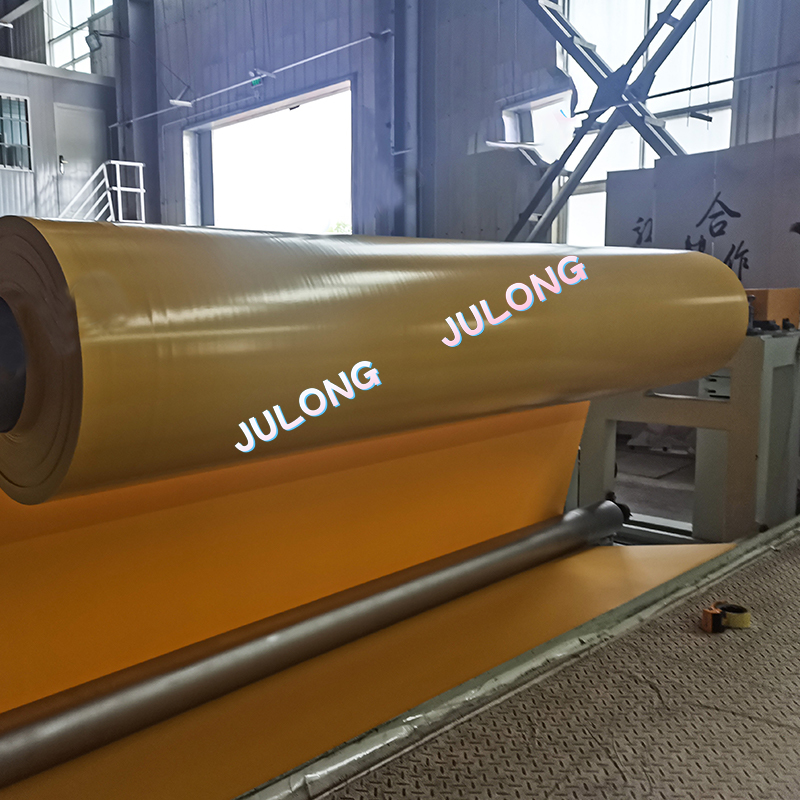
The total weight of the finished PVC tarpaulin — expressed in grams per square meter (gsm) — reflects the combined contribution of base fabric and coating and is the most commonly used single-number descriptor of material grade. Curtainsider tarpaulins range from approximately 500 gsm for lighter-duty applications to 900 gsm and above for heavy transport and long-service applications. The relationship between weight and performance is not perfectly linear — a heavier material is not always better for every application — but weight provides a useful first-pass quality indicator that correlates broadly with tensile strength, tear resistance, and coating thickness.
| Property | Test Standard | Typical Range (Curtainsider Grade) | Relevance |
| Weight | ISO 2286-2 | 500 – 900 gsm | Overall material grade indicator |
| Tensile strength (warp/weft) | ISO 1421 | 2,500 – 5,500 N/5 cm | Resistance to wind and cargo load forces |
| Tear resistance | ISO 4674-1 | 300 – 800 N | Propagation resistance after cuts or punctures |
| Cold flexibility | EN 1876 | No cracking at −25°C to −35°C | Prevents cracking during winter curtain operation |
| UV resistance | ISO 4892 (Xenon arc) | 1,000 – 2,000+ hours | Determines color retention and service life |
| Waterproofness (hydrostatic head) | ISO 811 | 2,000 – 4,000+ mm H₂O | Ensures cargo protection in heavy rain |
| Weld seam strength | ISO 1421 (at weld) | ≥ 85% of base material strength | Structural integrity at curtain panel joints |
In Europe, curtainsider tarpaulins used on vehicles operating on public roads must comply with the requirements of EN 12641-2, the European standard for sheet curtains used on road vehicles. This standard defines minimum requirements for the mechanical properties of the curtain material, the strength of seams and fixings, the performance of the curtain system under wind loading, and the marking requirements that allow curtains to be identified and their compliance status verified during roadside inspection.
The most practically significant requirement of EN 12641-2 is the wind resistance classification. The standard defines Class 1 curtains (tested to withstand 100 km/h wind loading) and Class 2 curtains (tested to 110 km/h). The wind resistance test is conducted on the complete curtain assembly — not just the tarpaulin material — including the curtain rail system, lashing straps, and fixing hardware. This means that a tarpaulin material that meets its own tensile strength specification may still fail the EN 12641-2 wind resistance test if the curtain system design is inadequate. Fleet operators and trailer manufacturers must specify and test the complete curtain system, not just the sheet material in isolation.
Compliant EN 12641-2 curtains must be marked with the manufacturer's name or trademark, the EN standard number, the wind resistance class, the date of manufacture, and a serial number traceable to production records. During roadside enforcement checks, inspectors verify these markings and may conduct visual inspections for damage that could compromise the curtain's structural performance. Operating a non-compliant or heavily damaged curtain on European roads can result in prohibition notices, fines, and fleet operator liability if cargo is lost or a third party is injured by unsecured freight.
Beyond the structural performance requirements of EN 12641-2, curtainsider tarpaulins used on vehicles above 3.5 tonnes GVW in Europe must carry retroreflective marking strips compliant with ECE Regulation 70 (Rear Marking Plates) and Directive 76/756/EEC on vehicle lighting. The standard retroreflective marking for curtainsiders consists of alternating yellow and red strips applied horizontally along the lower portion of the side curtain and across the rear, ensuring that the vehicle outline is visible to other road users at night and in poor visibility conditions.
The retroreflective strips used on curtainsider tarpaulins must be bonded or welded to the tarpaulin surface in a way that withstands the repeated flexing and environmental exposure of curtain service without delaminating or losing retroreflective performance. High-frequency (HF) welding of the strip to the tarpaulin surface is the most durable attachment method and is strongly preferred over adhesive bonding for new curtain fabrication. Strips that are only adhesively bonded may detach from the curtain surface after several seasons of outdoor exposure, creating a compliance problem and a safety hazard that requires curtain repair or replacement.
The method used to join tarpaulin panels and attach reinforcing elements, hems, and accessories to a curtainsider curtain has a direct impact on the curtain's waterproofness, structural strength at seams, and long-term durability. Two primary fabrication methods are used: high-frequency (HF) dielectric welding and sewn (stitched) construction.
HF welding uses a high-frequency electromagnetic field to generate heat within the PVC material itself, causing the PVC at the joint interface to melt and fuse together under pressure from the welding electrode. The result is a molecular-level bond between the two tarpaulin surfaces that creates a joint stronger than the parent material in peel (though not always in tensile strip test). Most importantly, HF welds are completely waterproof — there are no needle holes or thread interstices through which water can penetrate. For curtainsiders carrying moisture-sensitive cargo, or operating in sustained heavy rain, HF-welded construction is the correct specification. The vast majority of professional curtainsider fabricators use HF welding as their primary joining method for panel seams, hem edges, and accessory attachment.
Stitched seams using UV-stabilized polyester thread are used in some curtainsider applications, typically for attaching lashing loops, reinforcing tapes at curtain edges, and hem finishing on lower-cost curtains. Sewn seams are inherently not waterproof unless sealed with a PVC tape or liquid seam sealer applied over the stitch line after sewing. For fleets where absolute waterproofness is required, sewn construction without seam sealing is inadequate. Sewn construction is more commonly found in lower-specification curtains, repair sections replacing damaged areas, and in markets where HF welding equipment is not readily available to the fabricator.
Fleet livery printing on curtainsider tarpaulins has become a standard marketing and brand visibility tool for logistics and transport operators. A curtainsider travelling 150,000 km per year across Europe or North America represents a significant mobile advertising surface, and the investment in high-quality printed graphics is justified for many fleet operators. Understanding the print process and durability requirements helps buyers specify curtains that will maintain their visual quality throughout their service life rather than fading, cracking, or peeling within the first year.
Curtainsider tarpaulins are printed using large-format digital inkjet printers with UV-curable inks or solvent-based inks. UV-curable inks are cured immediately after printing by a UV lamp integral to the printer, producing a highly durable ink layer that is resistant to abrasion, chemicals, and weathering from the moment of printing. Solvent-based inks are absorbed into the PVC surface during printing and, after off-gassing of the carrier solvent, produce a durable image that is well-bonded to the substrate. Both systems are used commercially, and both can produce excellent outdoor durability when correctly applied and overlaminated with a UV-protective clear coat.
The printability of the tarpaulin surface must be specified when ordering material for printed curtains. Standard PVC tarpaulin has a relatively smooth, non-absorbent surface that may not provide sufficient ink adhesion for all printing systems without surface preparation. Printable-grade PVC tarpaulins are surface-treated during manufacture to improve ink adhesion and print quality, and should be specified whenever digital printing is planned. Attempting to print directly on untreated standard tarpaulin can result in poor adhesion, ink delamination, and color inconsistency across the print panel.
When procuring PVC tarpaulin material or complete curtain systems for curtainsider trailers, the following checklist covers the essential verification points that distinguish a correctly specified, compliant product from one that may cause operational, regulatory, or financial problems in service:
Win-win cooperation with new and old customers, create the future.

No. 9, Xingang Avenue, Ningguo City, Anhui Province, China.


+86 15397280550
Copyright © Anhui Longsheng New Material Technology Co., Ltd. Architecture Membrane Material Manufacturers Outdoor PVC Waterproof Fabric Supplier
