
 English
 عربى
عربىTarp for Truck Cover




Content
Pool safety barriers save lives. Drowning remains one of the leading causes of accidental death among children under five worldwide, and unsecured residential and commercial swimming pools represent a persistent and preventable hazard whenever adults are not present to supervise. Among the range of pool safety barrier solutions available — rigid aluminum fencing, removable mesh panel systems, automatic pool covers, and fixed enclosures — the 280G PVC mesh pool security barrier fabric has established itself as one of the most practically effective and widely adopted options for residential pool owners, hospitality facilities, and aquatic centers seeking a barrier that combines genuine physical security with visibility, ease of installation and removal, and durability under continuous outdoor exposure. Understanding exactly what 280G PVC mesh pool security barrier fabric is, how it is constructed, what performance standards it must meet, and how to evaluate and install it correctly is essential for anyone responsible for pool safety management.
The designation "280G" refers to the fabric weight — 280 grams per square meter — which is a standardized measure of how much material is present per unit area of the finished mesh fabric. In the context of pool security barrier fabric, this weight specification is a primary indicator of the fabric's density, strength, and durability. A 280 GSM PVC mesh fabric represents a medium-to-heavy weight construction that provides a meaningful improvement in tear resistance, dimensional stability, and long-term UV performance compared to lighter 100–180 GSM mesh fabrics used in shade sails and decorative applications, while remaining lighter and more manageable than heavy-duty 400–600 GSM industrial fabrics that would be unnecessarily stiff and difficult to handle in a removable barrier installation.
The fabric construction consists of a polyester yarn base — woven in an open mesh pattern that balances visibility through the barrier with resistance to wind loading — coated on both faces with PVC compound that bonds to the yarn intersections and fills the spaces between adjacent yarns partially or completely depending on the mesh aperture design. The PVC coating protects the load-bearing polyester yarns from UV degradation, moisture absorption, chemical attack from pool water and cleaning agents, and the abrasion that occurs at contact points with fence posts, tensioning hardware, and the ground. It also provides the smooth, easily cleaned surface that makes the barrier practical for regular maintenance in a poolside environment where chlorine, algaecides, and sunscreen residues accumulate on exposed surfaces throughout the swimming season.
The safety performance of a 280G PVC mesh pool security barrier fabric is determined not only by its weight but by the specific details of its construction — the yarn type and denier, the weave pattern, the PVC compound formulation, and the quality of edge finishing and hardware attachment points. Each of these variables has a direct effect on the barrier's ability to prevent unauthorized access and withstand the forces applied by a child attempting to climb over or push through it.
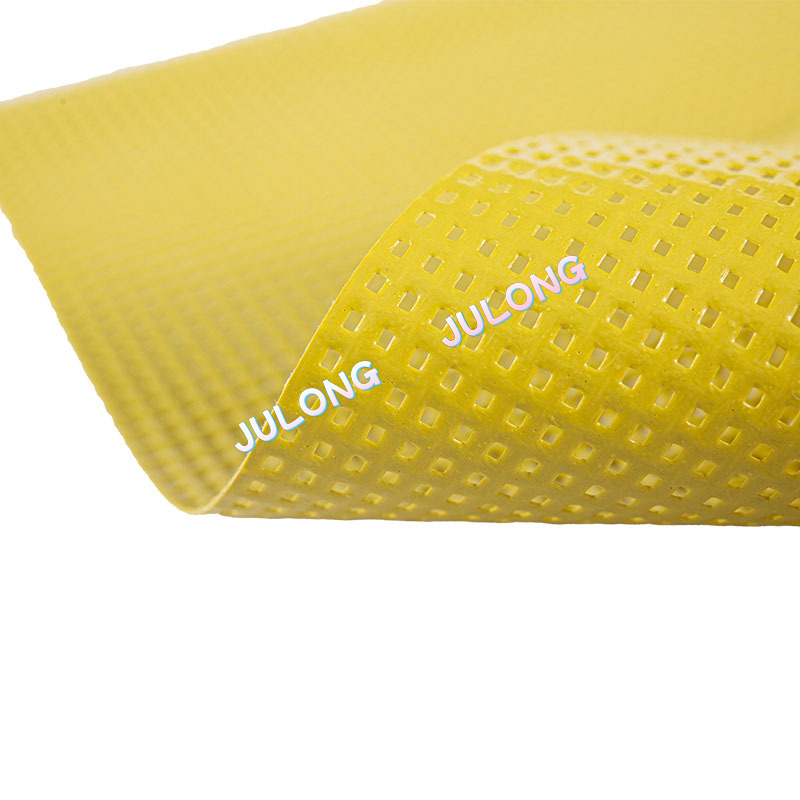
The load-bearing polyester yarns in a quality pool security barrier fabric are typically high-tenacity polyester — the same fiber grade used in industrial lifting slings and reinforced conveyor belts — rather than standard textile-grade polyester. High-tenacity polyester has a tensile strength approximately twice that of standard polyester, providing the tensile reserve needed to resist the concentrated loads applied at grommet holes and tensioning points when the barrier is under wind load or physical pressure. The weave pattern is typically a square or diamond mesh with apertures in the range of 3–8 mm, small enough to prevent a child's foot from being inserted for climbing while providing adequate air permeability to reduce wind loading on the installed barrier — a practical engineering compromise that balances security and structural efficiency.
The PVC compound applied to the yarn base must be formulated with UV stabilizers — typically hindered amine light stabilizers (HALS) and UV absorbers — to resist the photodegradation that causes unprotected PVC to become brittle, discolored, and structurally weakened over months of continuous outdoor exposure in sun-exposed pool environments. Quality 280G PVC mesh pool barrier fabrics are formulated and tested for outdoor service lives of 5–10 years, maintaining at least 80% of their original tensile strength and color after accelerated weathering testing equivalent to several years of outdoor exposure in a high UV environment. Cheaper products using lower-quality PVC without adequate UV protection may show surface chalking, color fading, and increased brittleness within a single pool season.
Evaluating pool security barrier fabric products requires understanding the key performance specifications and what they indicate about the barrier's ability to fulfil its safety function. The table below summarizes the most important specifications and their practical significance.
| Specification | Typical Value (280G) | Why It Matters |
| Fabric Weight | 280 g/m² | Indicates density, strength, and durability |
| Tensile Strength (warp/weft) | ≥ 1,500 / 1,200 N per 5cm | Resistance to tearing under load |
| Tear Resistance | ≥ 200 N | Resistance to propagation of cuts and holes |
| Mesh Aperture Size | 4–8 mm | Prevents foot insertion for climbing |
| UV Resistance Rating | ≥ 5 years outdoor service | Long-term performance without replacement |
| Air Permeability | Medium (reduces wind load) | Reduces structural stress on posts and anchors |
| Chemical Resistance | Pool chemicals, cleaners | Maintains integrity in pool environment |
| Color Fastness | Grade 4–5 (ISO 105) | Retains appearance throughout service life |
Tensile strength figures for pool barrier fabric are particularly important because they define the barrier's resistance to the pull and push forces that a young child — or a determined adult — might apply in attempting to breach the barrier. A fabric with tensile strength below 1,000 N per 5 cm strip is unlikely to provide reliable containment under sustained physical loading at grommet points and seam locations. The 280G weight class consistently delivers tensile values in the 1,200–2,000 N range for quality products, which represents a meaningful safety margin above the forces that can reasonably be generated by a child attempting to force passage through the barrier.
Pool barriers — including mesh fabric barriers — are subject to regulatory requirements in most developed countries that specify minimum height, structural integrity, and access prevention performance. Understanding the applicable standards for your jurisdiction is a prerequisite for specifying pool barrier fabric and hardware that will satisfy both legal requirements and insurance obligations.
Pool owners selecting a safety barrier system face a genuine choice between several fundamentally different approaches, each with distinct advantages and limitations. Understanding where 280G PVC mesh barrier fabric fits in this landscape helps in making an informed decision matched to the specific pool, property, and lifestyle requirements of the installation.
The safety performance of a 280G PVC mesh pool security barrier depends as much on correct installation as on fabric quality. An excellent fabric installed with inadequate post spacing, insufficient tension, or improperly secured anchors will fail to provide the barrier integrity that the fabric specification is capable of delivering. Following established installation principles is not optional — it is the mechanism through which the fabric's performance potential is translated into actual safety protection.
Standard removable mesh pool barrier systems use fiberglass or aluminum posts inserted into anchor sleeves drilled and set into the pool deck at intervals of 2–3 meters. Post spacing beyond 3 meters allows excessive fabric deflection under lateral load, reducing the effective barrier height when the fabric is pressed inward and creating a gap at the base of the barrier that a small child could potentially pass beneath. Anchor sleeves must be set in sound concrete at a minimum embedment depth of 100–150 mm and anchored with appropriate setting compound — shallow or improperly secured anchors are the most common installation failure mode and will pull out under the loads generated when a child pushes against the barrier or falls against it.
Mesh barrier fabric must be tensioned sufficiently to maintain a firm, taut surface that resists significant lateral deflection when loaded. A slack barrier can be pushed inward far enough to create a gap at the base through which a small child could crawl — defeating the primary safety function of the installation. Most standard systems achieve tension through the stiffness of the fiberglass posts in their sleeves combined with bungee cord or rigid connector attachment of the fabric panel bottom edge to the deck surface. The bottom gap between the fabric and the deck surface must not exceed 100 mm at any point along the installed barrier to prevent passage of a small child beneath the barrier.
Any access gate in a pool security barrier must meet the same height and structural requirements as the barrier itself and must be equipped with a self-closing, self-latching mechanism that automatically returns the gate to the closed and latched position after each use. A gate that relies on manual latching by users — including young children — is a predictable failure point in pool barrier security. Self-closing gates with spring-loaded hinges and height-mounted latches positioned above a child's reach are the minimum standard for compliant pool barrier gates, and this requirement applies equally to removable mesh barrier systems and permanent fencing installations.
A 280G PVC mesh pool security barrier requires regular inspection and maintenance to ensure it continues to function as intended throughout its service life. The combined effects of UV exposure, pool chemical contact, physical loading from wind and incidental contact, and the mechanical stresses of repeated installation and removal cycles progressively affect fabric strength, grommet integrity, and post anchor security over time.
Choosing a 280G PVC mesh pool security barrier system involves evaluating the fabric specification, the post and anchor system, the gate hardware, and the supplier's compliance documentation as an integrated package rather than assessing each component in isolation. A fabric panel that meets all performance specifications delivers no safety benefit if it is attached to posts anchored inadequately or if the gate fails to latch reliably after each use.
Request test reports or certification documentation from barrier system suppliers demonstrating compliance with the applicable standard for your jurisdiction — ASTM F2286/F2715 for the US, AS 1926.1 for Australia, or relevant national standards for other markets. Verify that the test reports cover the complete system as installed rather than fabric-only tests, since system performance under lateral loading depends on the interaction between fabric tensile properties, post stiffness, and anchor holding strength acting together. Confirm the specified barrier height — measured to the top of the fabric panel in the installed, tensioned configuration — meets the minimum requirement of the applicable standard, and verify that the gate mechanism is self-closing and self-latching to a height that places the latch beyond the reach of a young child. Finally, ensure the supplier provides clear installation instructions, anchor spacing specifications, and recommended inspection intervals, and that local installer support or clear DIY installation guidance is available for your specific pool perimeter configuration.
Win-win cooperation with new and old customers, create the future.

No. 9, Xingang Avenue, Ningguo City, Anhui Province, China.


+86 15397280550
Copyright © Anhui Longsheng New Material Technology Co., Ltd. Architecture Membrane Material Manufacturers Outdoor PVC Waterproof Fabric Supplier
